
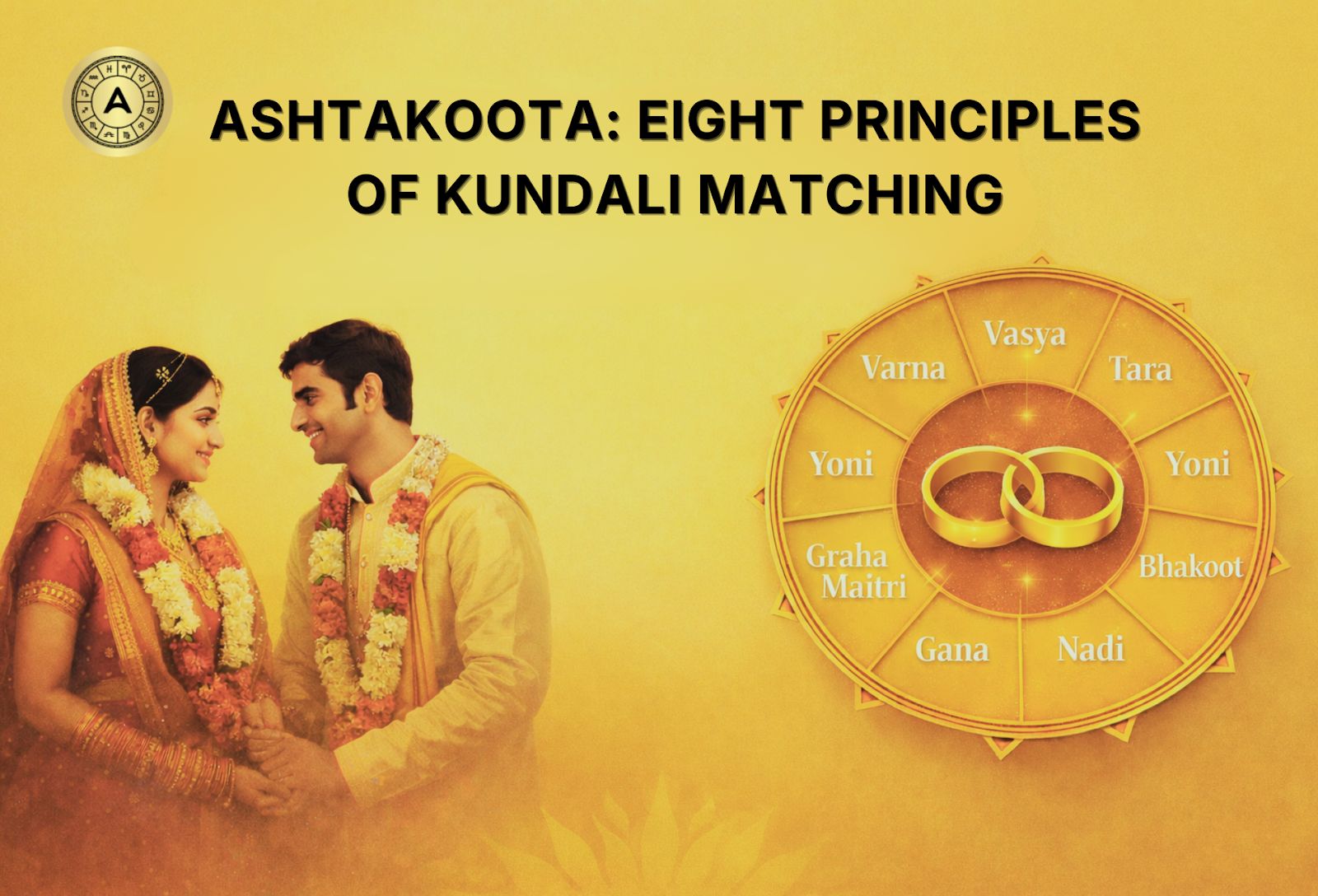
It is a saying in Indian weddings that the marriages are made in heaven; however, it is on earth that two individuals, along with their families, must learn to coexist, learn to love and learn to grow together. To facilitate this, generations of astrologers have been studying birth charts (Kundalis) and have created methods to analyze compatibility. Ashtakoot milan, which is also called "ashtakoot matching" or "ashtakoot gun milan," is one of the most common means to evaluate relationship compatibility in marriages. This old system considers eight major elements or kootas, of the charts of a couple to give an insight into the way they will be in emotional, physical and spiritual ways. This article will decode the eight kootas, see how they are computed and read them.
What Is Ashtakoot Milan?
Ashtakoot is a word derived from the Sanskrit ashta (eight) and koota (aspect). Each of these eight kootas contributes a fixed number of points, known as gunas, which together measure marital compatibility. Guna is quality and guna matching is comparing these qualities of two charts. The ashtakoota approach used for Kundali matching in marriages assigns a point value to each koota, with the total score of 36 points representing the couple's overall compatibility. Here, 18 is an acceptable score, 24-32 is considered good, while 32-36 is seen as an exception. If a score is less than 18, then it indicates that the relationship may require a lot of work or adjustments in order to make it work.
Though the system was invented in northern India, it has some regional variations. The Southern system of Dasha Koota judges on ten criteria and Tamil astrologers apply Porutham to judge on up to ten or more criteria. Irrespective of these differences, the main principle is identical, i.e., knowing how two energies can harmonize. Ashtakoot is like a weather forecast for a marriage: it does not tell your future exactly, but it helps you plan and prepare.
The Eight Kootas Explained
Different dimensions of compatibility are covered by each koota. Think about you checking a house before purchasing. You would not judge it by its roof only; you would examine the foundation, plumbing system, electrical wiring and neighborhood. Similarly, the eight kootas provide a holistic view of a relationship. The following is a list of each of the aspects and their importance:
1. Varna—Spiritual and Social Alignment (1 point) Varna represents the connection of a person to spirituality and how they deal with the duties of life. The Varna system divides people into four groups: Brahmin, Kshatriya, Vaishya and Shudras. This is not based on the principles of the social hierarchy, but rather it helps to identify the compatibility in the personality and the purpose of life. Varna can be used to show how partners help one another to grow in the modern environment. You get one point when both of you share the same Varna.
2. Vashya—Mutual Influence and Attraction (2 points)
Vashya also shows the way partners affect one another and who is more likely to be the leader. It also compares their lunar stars (Nakshatras) and divides them into classes such as Chatushpada (quadruped), Avesh (wild), Vanchar (travellers), Jalchar (aquatic) and Keet (insects). A good Vashya match means both partners give and take equally. In ashtakoot gun milan, the highest point in this category is two, which indicates that the couple has personal chemistry.
3. Tara—Well-being and Long life (3 points)
Tara analyzes the health and life expectancy by analyzing the distance between couples based on Janma Nakshatras. Some of the combinations are believed to be good and promote stability and complement each other; however, some other combinations may show some challenges that demand awareness and adaptability. Tara considers that physical and emotional health are very important for a happy marriage; that is why it gets 3 points.
4. Yoni—Intimacy and Sensuality (4 points)
The word "yoni" means "source," and it is a symbol of creative intimacy in individuals. The Nakshatras have got animal symbols and the Yoni connection is understood by observing how the animals deal with each other. The Yoni match is beneficial to achieve physical and emotional intimacy and if there is a mismatch, it may require conscious effort to resolve the differences. Think of it as the plumbing of your house: everything is good when it is smooth, but when it is blocked up, then life becomes challenging.
5. Graha Maitri—Mental and Intellectual Harmony (5 points)
Graha Maitri looks at friendship and psychological bonds between partners based on their moon signs. It gives a maximum of five points, which shows its importance in everyday lives. Two points are awarded on the distances between the Moon signs. People with the same sign usually make the strongest couples. Those with different signs may need to build patience and mutual respect over time, which makes Graha Maitri one of the most important factors in eight koota matching.
6. Gana—Temperament and Behaviour (6 points)
Gana divides people into three personality types: Deva (selfless and calm), Manushya (balanced and practical) and Rakshasa (energetic and assertive). In Guna Milan, a person's Gana is identified by the Moon's Nakshatra in the birth chart, as each Nakshatra is assigned a specific Gana. The maximum points allowed by this koota is six, based on how well the partner's Gana types match. It focuses on daily practices and emotional responses, such as the way you solve a conflict or plan a vacation or the way you react to a sudden incident.
7. Bhakoot—Financial and Emotional Stability (7 points)
The Bhakoot is a distance that is measured between the Moon signs of the couple to estimate the financial well-being, family balance and emotional stability. Some mixes are believed to boost joint prosperity, whereas the others can be an indication of some difficulties, like failure to understand each other or baby procrastination. Since Bhakoot has seven points, it highlights the importance of emotional and financial security in married life.
8. Nadi—Health and Genetic Compatibility (8 points)
Nadi is probably the most heavily weighted aspect, with a maximum of eight points. It looks at three energy paths that are Aadi (Vata), Madhya (Pitta) and Antya (Kapha), which are related to the Nakshatras matching of both partners. The similar Nadis of both partners may suggest health concerns for children, but if their Nadis are different, the match receives full points.
Understanding the Scoring System
In the ashtakoot system in astrology, Nadi carries the highest weight with eight points, while Varna has only one point. This weighting reflects the importance of each factor. When the points are counted, the score obtained is going to fit into four broad categories:
32-36 points - Excellent
Uncommon and very harmonious match.
24-31 points - Very good
Excellent connection with the need for little awareness.
18-23 points - Acceptable
The harmony is sufficient, but there should be understanding and efforts between each other.
Below 18 points – Challenging
The differences can be significant; the couple is advised to refer to an astrologer so that remedies are provided and compatibility can be improved.
It should also be kept in mind that such scores are guidance, not a fixed decision. Communication, respect and shared values are common in many couples with lower scores to build fulfilling relationships. On the same note, good scores cannot guarantee a flawless marriage without working.
Beyond Numbers: Details and Modern Perspectives
Minor Details Not Often Discussed
Interplay of Kootas
Traditional articles used to treat the pieces of kootas individually, but actual relationships would be a combination of these energies. The effect of a lower Yoni score can be minimized by a high Graha Maitri (mental harmony); for example, a couple may have a low Vashya (dominance) but balanced Varna and Gana, resulting in a push-pull dynamic. The analysis of thousands of historic charts shows that some factors often balance others.
Cultural Evolution
Varna and Gana categories come from ancient roles of society. Today, they are better understood as personality types, not fixed social labels. Applying ashtakoota-based marriage matching into the modern context (i.e., the style of leadership, conflict resolution, interests in lifestyle, etc.) will make the practice more relevant.
Geographical differences
South Indian astrologers operate on ten-fold or Dasha Koota, whereas Tamil porutham matches include things like Mahendra (progeny) and Rajju (husband's longevity). Even in the eight kootas, there may be variations in the way of scoring. An example is that Bhakoot or Nadi points are sometimes modified by astrologers when the ruling planets are favorable so that astrology is not rigid.
Integration with Psychology
Relationship psychology studies put stress on the role of communication, common beliefs and emotional intelligence. Koota points become easier to understand when linked to Guna matching. An example of this is a low Graha Maitri would help a couple to enhance their listening abilities, whereas a high Nadi would suggest they maintain joint health routines as a priority.
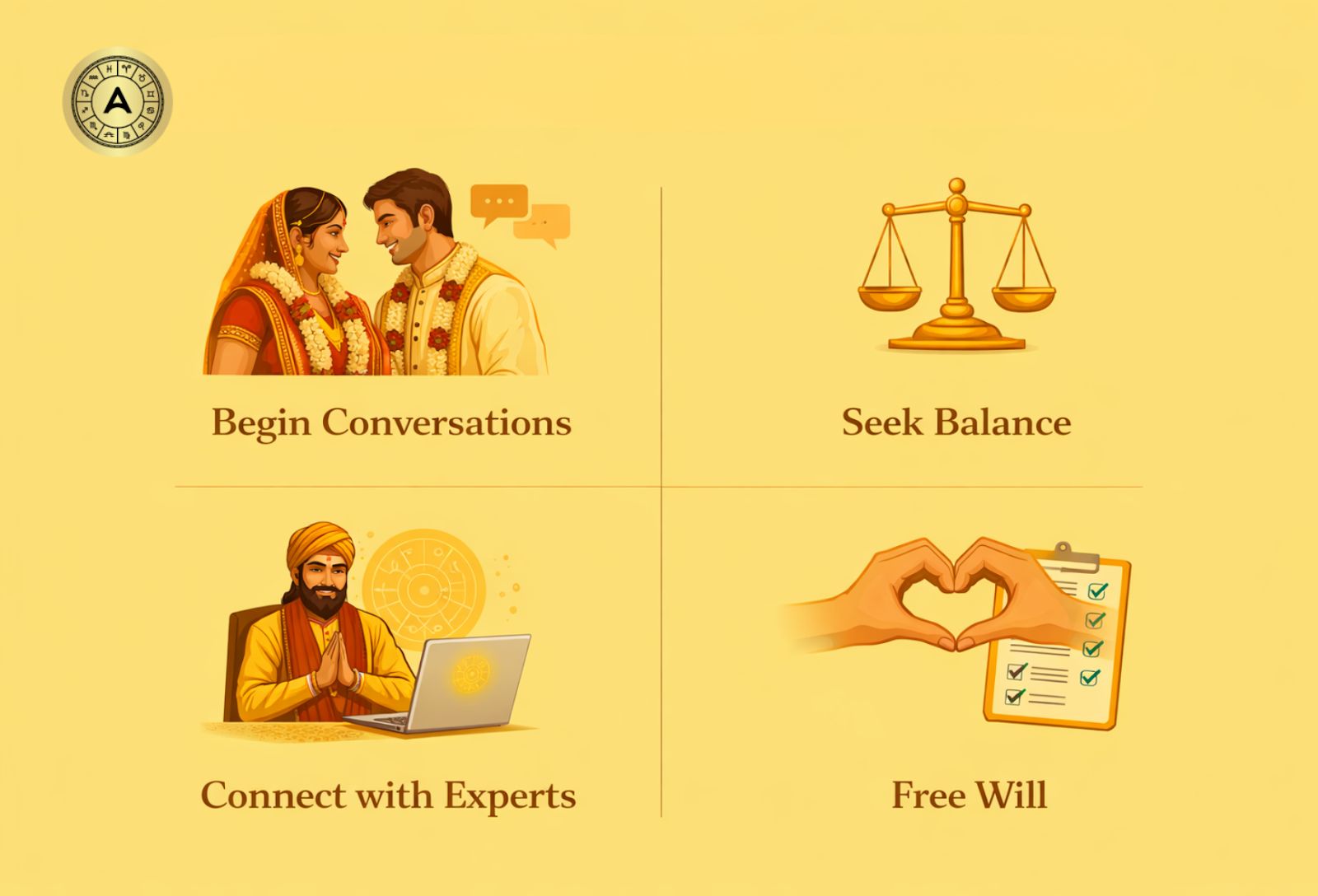
How to Use Ashtakoot Results Wisely
Begin Conversations
The score is not about judging anyone but about discussing expectations, values and future goals. Questions like "How do you deal with stress?" or "What is your spirituality?" align with Vashya, Varna and Graha Maitri.
Seek Balance
There is no couple that will achieve the same score in all the kootas of ashtakoot kundali matching. Identify strengths and think about how to deal with weaknesses. As an example, when Nadi recommends possible health issues, encourage healthy living.
Connect with Experts
An interview with one of the expert astrologers or AI astrology platforms like Astro247 can provide some clear context and emotions. They are able to clarify exceptions and prescribe solutions like mantras or rituals and they can guide you through complex consequences like Manglik dosha or Dashakoota.
Free Will
Astrology suggestions are highly dependent on patterns, but not predetermined outcomes. Couples who have moderate and low scores have the potential of building strong relationships based on empathy, compromising and experience. Ashtakoot is not a judge but a guidepost.
How Astro247 Supports Ashtakoota Matching with Clarity
Ashtakoot can be understood much better when the calculations are accurate and the insights have been well explained. Astro247 assists in simplifying this by correctly analyzing nakshatras, Moon signs and the eight kootas with no confusion and inconsistency. After studying thousands of chart patterns, the system indicates the areas of Ashtakoot gun milan that are naturally aligned and those that might require awareness and understanding of each other.
Astro247 focuses on meaningful interpretation, not on a final score. It assists the couples to visualize the strong points, know the weak spots and realize what matters in the long-run connection. It is like having a trustworthy mentor that narrates it in a very simple manner that makes the couple take the decisions regarding marriage with confidence and not with doubt.
Conclusion
Ashtakoota matches eight aspects and highlights the different sides of a relationship. The analysis of the eight kootas allows seeing the complete picture of how two lives could be integrated together, including spiritual connection, emotional balance and physical health. Although the traditional Vedic system is the one that gives points and categories in this, modern practitioners introduce refinement, context and ease of use. Ashtakoot matching provides a platform of reflection, discussion and development, whether you need to see how compatible you are or you want to understand the complexity of your relationship. It is a guide to increase awareness and enjoy building a life together.
Frequently Asked Questions
About the Author
Jyotish Rahul
10+ years ExperienceJyotish Rahul has been a Vedic astrologer for more than 10 years. He is known for his calm guidance and specializes in kundali analysis and planetary influences, helping people make confident life decisions. With a warm counselling style, he helps clients understand their charts and navigate life's important decisions.